Early to mid-September is prime time to consider overseeding or interseeding your lawn. The benefits of seeding now are much more significant than when they are done in the spring, but why? Let’s take a closer look at what makes this time of year the best for seeding your lawn, as well as what to do in the case of needing new grass.
Overseeding vs. Interseeding
In order to understand the success of seeding this time of year, we should first clarify the two different types of seeding we’re talking about.
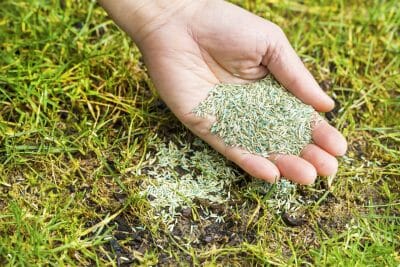
Overseeding is the task of planting grass seed directly into existing soil without tearing the soil or turf. This gives your lawn thicker growth, better color, and greater resistance to the elements.
We’ll use the technique of overseeding when the grass begins to thin and allows room for weeds to grow as the grass reproduction slows down over time. This process helps your lawn compensate for slower reproduction and creates much thicker grass. It is also an ideal investment because it can reduce the amount of fertilizer, pesticides, and water the lawn will need over time. Not to mention the fact that renovated lawns can stay greener and can retain their look and health longer.
Interseeding, on the other hand, is performed by seeding the same grass species into itself to create a more dense look and recover any grass that’s been lost. Determining when to use either technique is largely dependent upon the state of the lawn. If the bare areas are the size of soccer balls or larger, or if the area only has sporadic green patches of turf, then interseeding is necessary to restore the area.
Why September for Seeding?
There are a few primary reasons why September, or early Fall in general, is an optimal time for seed growth.
Ideal temperature
Early fall is ideal for grass growth due to the fact that the soil is still warm from the summer heat. The seeds will germinate best when the soil reaches between 50 and 65 degrees Fahrenheit, which coincides with the daytime air temperatures reaching between 60 and 75 degrees Fahrenheit.
Chris Raimondi’s recent feature on News12’s “The Real Deal” has shed light on the pressing issue of spotted lanternflies and their potential to wreak havoc on food prices. It’s imperative that we take action now to prevent this threat from adversely affecting our economy in the future. Here are some steps you can take to […]
Ivy improving indoor air quality? Philodendrons linked to productivity? Incredible, but true. According to the interior plants industry organization Plants at Work, Los Angeles, there are four proven bottom-line benefits created by interior plants. […]
Since September 11, 2001 the odds of a biological chemical attack in America have greatly increased. An attack such as this could be devastating to a massive number of Americans while having severe economic consequences. The most likely approach terrorists might use is to employ an aerosolizer to release biological and chemical warfare agents into […]

 In order to understand the success of seeding this time of year, we should first clarify the two different types of seeding we’re talking about.