The Spaces That Work (and Why Most People Struggle to Explain Why)
By Jean-Pierre Sijmons
Read The Original Post On LinkedIn
Most commercial spaces look like they should work. And somehow… they don’t.
The furniture is expensive. The lighting was “thought through.” Every box on the design checklist was ticked.
And still, the space feels flat. Transactional. Easy to move through—and just as easy to forget.
If you’ve spent time in enough offices, hotels, hospitals, or lobbies, you know exactly what I mean.
Then there are spaces that slow you down.
You can’t always explain why. You just feel it. You linger. You breathe differently. You want to be there.
That difference is where things get interesting.
After years of working with facility managers, designers, and developers, I’ve come to a conclusion that continues to surprise some clients:
This gap almost never comes down to budget. It comes down to decisions most people don’t even realize are being made.
Where “Biophilic” Often Falls Short
Biophilic design is everywhere now. References to nature. Natural colors. Organic forms. Materials that suggest the outdoors.
But here’s the uncomfortable truth: Spaces that only reference nature rarely create the same pull as spaces that actually contain it.
There is a real, measurable difference between a space designed around biophilic principles and a space that integrates living plants as functional, spatial elements.
People sense that difference immediately, even if they can’t articulate it.
What Clients Pay For (and What They Don’t Know They’re Missing)
When organizations invest in commercial interiors, they focus on what’s visible and familiar:
Furniture Flooring Finishes Layouts
That makes sense. It’s what everyone can point to.
What rarely gets discussed are the elements quietly doing the heaviest lifting, because they’re harder to describe and even harder to spec well.
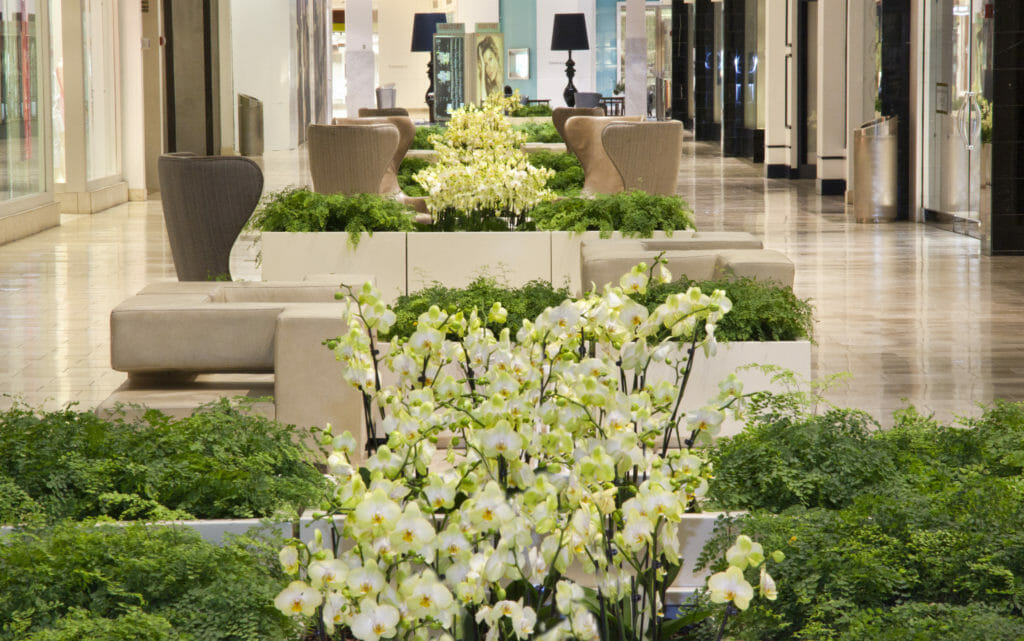
A living wall in a reception area isn’t just decorative. It changes how people regulate themselves the moment they arrive.
Planter placement in an open-plan office isn’t random when it’s done well. It creates zones, softens transitions, and subtly guides focus, movement, and pause.
When those decisions are skipped, simplified, or treated as an afterthought, the cost never shows up on an invoice.
It shows up in how people feel about being there.
And that has real consequences: Retention. Productivity. Brand perception.
If you’ve ever heard someone say, “I can’t explain it, but I don’t love being in that space,” this is usually why.
The Specification Decisions No One Sees (Until Later)
Here’s something that doesn’t get enough airtime:
Most of what determines whether a space still performs five years from now is decided at the specification stage, not during installation.
The difference often looks like this:
- A planter engineered for atriums, rooftops, or high-traffic environments versus one that looks identical in a showroom but fails under real conditions.
- A living wall system with accessible irrigation and service points versus one that requires partial removal for routine maintenance.
- Finishes that hold color under UV exposure and commercial lighting versus ones that start fading within eighteen months.
Clients don’t ask about these things because they don’t know where future problems originate.
And to be fair, specifiers who don’t raise them aren’t necessarily cutting corners. Many simply haven’t lived through enough long-term outcomes to see how and where failures surface.
This is where specification quality becomes a real competitive advantage.
Not for the specifier. For the client who has to live with the space.
The Question Most Projects Never Ask
There’s one question that should be raised early in every serious project conversation:
What do you want people to feel in this space?
Not what you want it to look like. Not what the budget is.
What do you want people to feel when they walk in, sit down, meet, or spend eight hours of their working life there?
It almost never gets answered quickly.
But when it does, when someone really thinks it through, the entire specification process shifts.
The conversation stops being about whether something fits. It becomes about whether the environment is actually working toward a specific outcome.
That’s a very different brief. And it produces very different results.
Why the Invisible Work Matters Most
The best-performing spaces rarely announce themselves.
They’re the ones where every decision, container selection, plant choice, placement, finishes, access, and long-term viability, was made with a clear understanding of what the space needed to do.
They don’t rely on biophilic cues alone. They use living plants to shape behavior, mood, and experience.
That doesn’t happen by accident.
It comes from asking better questions, knowing what fails when those questions aren’t asked, and being willing to have tougher conversations early, rather than far more expensive ones later.
Curious to hear from others here:
Have you walked into a space that looked right but didn’t feel right? Or a space that worked brilliantly, even if you couldn’t immediately explain why?
What do you think made the difference?
If this way of thinking resonates, the Planter Trends newsletter goes out monthly. Worth a follow if you work in or around commercial interiors.
By Jean-Pierre Sijmons
Read The Original Post On LinkedIn